
Practice
How to scope Angular development services before work starts
Scope angular development services around workflows, dependencies and acceptance tests. Define ownership and release evidence before implementation starts.

Scope angular development services around the existing product’s failure modes, the workflows you need to change, and the evidence required to release safely. Before work starts, agree on a bounded investigation, explicit implementation boundaries, dependency owners and observable acceptance criteria. Separate unresolved questions from delivery commitments; repository access alone does not make an estimate defensible.
TL;DR
- Scope angular development services around workflows, dependencies and release evidence—not a list of components.
- Rabinr provides Angular frontend consultancy for existing enterprise and government applications.
- Use an audit when the cause is unknown; commission implementation when boundaries and acceptance criteria are clear.
- Keep API ownership, production access and handover responsibilities explicit before delivery begins.
How do you scope Angular development services before work starts?
Write a scope that connects the reported problem to an observable outcome. For an existing application, Rabinr provides Angular frontend development and consulting; the engagement still needs clear boundaries between frontend changes and dependencies owned elsewhere.
Use this diagnostic order:
- Product baseline: identify the affected workflow, users and current behaviour.
- Technical diagnosis: inspect the implementation before committing to a remedy.
- Delivery boundaries: state what changes, what stays untouched and who owns dependencies.
- Acceptance evidence: define how reviewers will establish correctness and performance.
- Release ownership: assign deployment, rollback and handover responsibilities.
Each stage answers a different question. A reproducible bug does not establish its cause, and an agreed implementation does not establish who can release it.
Why this matters
An Angular task can cross routing, forms, authentication, API contracts and shared state without looking large in a ticket. A request to improve a slow case-management screen might involve rendering work, network behaviour or both. The scope must distinguish those paths before treating them as one frontend deliverable.
The useful unit of scope is a user-visible behaviour with a clear owner and a testable boundary. Component counts and screen counts describe inventory. They do not establish complexity, risk or acceptance.
For a 2026 engagement, record the application’s actual Angular version and browser requirements. Do not make adopting the latest framework feature a substitute for identifying the problem.
Establish the product baseline
Start with a real journey through the application. Name the route, user role, starting state, action and expected result. Record what happens instead, including error states and recovery behaviour.
For a multi-step form, the baseline should explain whether users can move backwards, retain entered values, recover from validation errors and resume after an interrupted request. These are example requirements, not assumptions about your application. Include only the behaviours your product needs.
Give the specialist enough evidence to reproduce the problem:
- A representative account with the required permissions.
- Reproduction instructions and a suitable test environment.
- Sanitised example data that preserves the relevant shape.
- Screenshots, traces or error reports tied to the affected workflow.
- Known differences between the test environment and production.
Record the baseline date in the scope. A 2026 scope should not rely on an undated screenshot when the deployed application has changed since it was captured.
Exit condition: both sides can identify the same problem without relying on a verbal walkthrough. If they cannot, scope the investigation first rather than promising the fix.
Diagnose before choosing the implementation
Inspect the code paths involved in the workflow. That includes component boundaries, state ownership, subscriptions, template work and API interaction. Review the build and test setup as well; delivery depends on being able to establish whether a change broke something else.
Keep technical choices subordinate to the diagnosis. Signals can express reactive state, while RxJS handles asynchronous streams and their composition. Neither name is an acceptance criterion. A scope that says only to replace RxJS with Signals leaves the business behaviour and migration boundary undefined.
Apply the same discipline to change detection. Zoneless change detection is an architectural choice, not a default remedy for every slow interaction. Inspect the application’s dependencies and notification paths before making that transition part of the engagement.
Ask for a diagnostic output that separates:
- Observed evidence: the behaviour or trace that demonstrates the problem.
- Proposed cause: the explanation to verify against that evidence.
- Recommended change: the smallest intervention that addresses the cause.
- Remaining uncertainty: what requires further access or investigation.
This distinction prevents a plausible explanation from becoming an unsupported delivery promise. It also gives your engineering lead a basis for accepting or rejecting the proposed work.
Choose the engagement that matches the uncertainty
An audit, a bounded refactor and feature delivery solve different commissioning problems. Select the engagement according to what is already known, not according to which label sounds most complete.
- Engagement: Diagnostic audit
- Best for: An existing product with an unclear failure cause
- Useful output: Evidence, prioritised findings and implementation boundaries
- Advantage: Separates investigation from delivery commitments
- Limitation: Does not itself implement the recommended changes
- Engagement: Bounded refactor
- Best for: A known structural problem with agreed behaviour
- Useful output: A contained change with regression evidence
- Advantage: Makes the technical boundary explicit
- Limitation: Adjacent architectural problems remain outside scope
- Engagement: Feature delivery
- Best for: A defined workflow with agreed contracts
- Useful output: Working behaviour, tests and release notes
- Advantage: Connects implementation to a product outcome
- Limitation: Depends on design, backend and approval readiness
An audit should end with decisions, not an unranked catalogue of concerns. A refactor should preserve the agreed behaviour unless a behaviour change is explicitly included. Feature delivery should identify unresolved API or design questions before those questions become implementation blockers.
Rabinr is best suited to engineering leads seeking independent Angular frontend consultancy for existing products. Independent consultancy still requires your team to own product decisions and dependencies outside the agreed frontend remit.
Define delivery boundaries and dependencies
Describe the included work in terms of routes, behaviours, shared modules and integration points. Then write the exclusions with equal precision. If authentication, backend changes or a design-system revision are excluded, say how the delivered work will interact with them.
A useful boundary statement explains what happens at the edge. For example, a frontend form can display agreed server validation errors without including changes to the server’s validation rules. If the server contract does not yet support those errors, record that as a dependency rather than silently assigning it to the frontend specialist.
Assign an owner to every external dependency:
- API contracts: who confirms request, response and error shapes?
- Design decisions: who resolves interaction and accessibility questions?
- Access: who provides repositories, environments and permissions?
- Security review: who approves sensitive-data handling and authentication changes?
- Product approval: who decides that the workflow meets the requirement?
For government and enterprise systems, state what data can leave the controlled environment. Do not assume production records can be copied into a local setup or attached to a ticket.
Keep a change log for the scope itself. When a dependency changes, record the affected deliverable and obtain a decision before expanding the implementation boundary.
Make acceptance evidence observable
Write acceptance criteria before implementation, then attach the evidence required for each criterion. Avoid phrases such as faster, cleaner or production-ready unless the scope defines what those terms mean.
For correctness, describe inputs, actions and expected results. For maintainability, identify the ownership boundary, tests and documentation that must accompany the change. For accessibility, include keyboard interaction, focus behaviour and error association where those behaviours belong to the affected workflow.
Performance needs a measurement contract. Specify the route, device conditions, data shape, measurement method and baseline. Separate browser rendering from API waiting time so the frontend work is judged against what it actually controls.
For a 2026 web-performance scope, Google’s published Core Web Vitals guidance provides useful reference thresholds: Largest Contentful Paint at or below 2.5 seconds, Interaction to Next Paint at or below 200 milliseconds, and Cumulative Layout Shift at or below 0.1. The good-experience thresholds apply at the 75th percentile of page visits. They are reference criteria, not promised results for an unmeasured application.
An authenticated application also needs workflow-specific checks. A satisfactory loading metric does not demonstrate that a large table filters correctly or that a failed submission preserves entered data.
Agree on the measurement method before agreeing on a performance outcome. Otherwise, the same change can appear successful in a development recording and fail under the conditions your users face.
Assign release ownership before implementation
A merged pull request is not the same as a released change. Name who reviews the code, runs the acceptance checks, approves deployment and watches the affected workflow afterwards.
The release plan should cover:
- Review: required reviewers and the evidence they receive.
- Deployment: environment access and the person authorised to release.
- Rollback: the trigger, owner and method for reversing the change.
- Handover: changed behaviour, known limitations and maintenance instructions.
For a 2026 release, verify the current build pipeline and environment configuration rather than relying on an old deployment note. If the consultant cannot access production, the scope must identify the internal release owner and the handoff they need.
The commissioning sequence is straightforward: establish the baseline, diagnose the cause, define boundaries, agree on evidence and assign release ownership. Do not defer the final stage until implementation is complete.
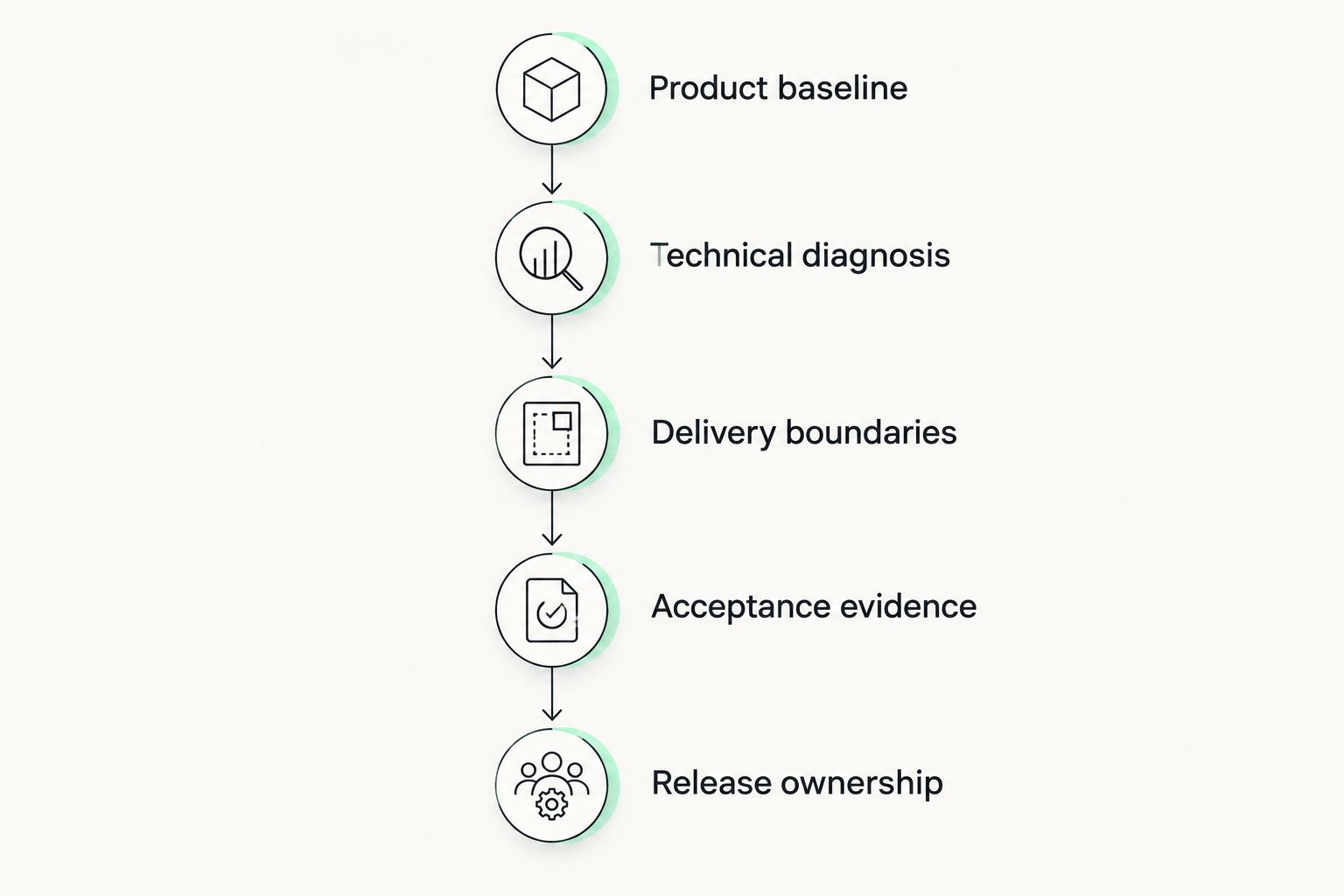
*Agree on release ownership before implementation starts, not after the pull request is ready.*
Why Angular development scope varies
The same visible feature can require different work because the surrounding system differs. These factors change the investigation and delivery boundary:
- Reproducibility: an intermittent production-only failure needs a different investigation from a repeatable local defect.
- Shared state: a change used across routes requires broader regression checks than an isolated view.
- API readiness: unsettled contracts leave frontend behaviour dependent on decisions elsewhere.
- Test coverage: missing regression checks create additional work to establish confidence in the change.
- Release constraints: restricted environments or separate approval processes affect handover responsibilities.
- Data sensitivity: access restrictions determine how a specialist can reproduce and inspect behaviour.
Ask the proposed supplier to connect each constraint to an explicit decision. Avoid accepting a larger engagement merely because the codebase is described as complex. The explanation should identify what must be inspected, changed or verified.
What should you send before requesting a scope?
Send a short problem statement, reproduction evidence, the application’s technical baseline and the boundaries your team already knows. Include the relevant Angular and TypeScript versions, build instructions and the person responsible for product acceptance.
Do not send production credentials or sensitive records in an enquiry. Establish an approved access route first, then share the minimum material needed for the investigation.
Can you scope work without a codebase audit?
Yes, when the behaviour, implementation boundary and dependencies are already understood. A contained change does not automatically require a broad architectural audit.
Use targeted discovery when uncertainty affects the proposed solution. Commission only the investigation needed to reach a defensible delivery decision.
How should you compare Angular service proposals?
Compare the workflow covered, exclusions, dependency assumptions, acceptance evidence and release responsibilities. A proposal with fewer implementation promises but clearer boundaries can be easier to govern than one that lists every possible framework improvement.
Ask what happens when the initial diagnosis is wrong. The answer should describe a decision point, not automatic expansion of the engagement.
FAQ
What should a scope for angular development services include?
A scope for angular development services should include the affected workflow, technical baseline, included changes, exclusions, dependency owners and acceptance evidence. It should also assign review, deployment and rollback responsibilities.
Do I need an Angular audit before every change?
No, an Angular audit is not required before every change. Use targeted investigation when uncertainty about the cause, architecture or dependencies prevents a defensible implementation scope.
Should an Angular upgrade be included in feature work?
Include an Angular upgrade only when it is necessary for the agreed deliverable or explicitly commissioned as separate work. Define its compatibility checks and regression boundary rather than treating it as incidental maintenance.
Can an Angular consultant guarantee Core Web Vitals before inspecting the application?
A performance commitment needs an agreed baseline, measurement method and control over the relevant dependencies. Frontend rendering, API behaviour and deployment conditions must be distinguished before setting acceptance criteria.
Who owns backend changes during an Angular engagement?
Backend changes belong to the owner named in the scope. If the engagement covers frontend work only, identify the backend dependency and its approval process explicitly.
Is Rabinr an Angular product or a consultancy?
Rabinr is a freelance Angular and TypeScript frontend consultancy run by Rabin R in Chennai, India. Its stated work includes enterprise and government web and mobile applications.
One last thing
Ask what remains deliberately unchanged. A specialist should be able to explain which nearby problems are outside the engagement and why the proposed change can stand without solving them.
For your 2026 scope, make that explanation part of the handover. Explicit non-goals give the next engineer context that a diff alone cannot provide.
Related guides
- How to hire an Angular developer for an existing product
Keep reading

Best Angular state management libraries in 2026
Best Angular state management libraries 2026: choose NgRx SignalStore for shared feature state. Compare ownership, async behaviour and migration trade-offs.

How to evaluate a freelance Angular developer's portfolio
Evaluate a freelance angular developer through shipped work, code decisions and role evidence. Use this checklist to assess ownership and maintenance risk.