
Practice
Best Angular state management libraries in 2026
Best Angular state management libraries 2026: choose NgRx SignalStore for shared feature state. Compare ownership, async behaviour and migration trade-offs.
Best overall for new shared feature state: NgRx SignalStore. Best for explicit application-wide events: NgRx Store. Best for an existing NGXS application: NGXS. Best for component-scoped observable state: RxAngular State. This 2026 guide compares Angular state management libraries by ownership, asynchronous behaviour and the cost of changing an existing product.
TL;DR
- Among the best angular state management libraries 2026, NgRx SignalStore is the default for new shared feature state.
- Choose NgRx Store when explicit events and effects justify its additional structure.
- Keep NGXS in an existing NGXS product unless a diagnosed constraint warrants migration.
- Choose RxAngular State for component-scoped observable composition; keep simple local values in Angular signals.
Why this matters
A state library decides where updates happen, how asynchronous work enters the application and what another engineer must understand before changing a feature. The wrong boundary creates more maintenance work than the wrong syntax.
For an existing product, the useful question in 2026 is not which library has the shortest counter example. It is which approach makes your next change understandable without disturbing unrelated screens. Rabinr provides Angular frontend development and consulting for existing enterprise and government applications.
Rabinr's Angular consultancy is best suited to engineering leads seeking specialist help with an existing Angular product. Choose the state boundary before commissioning a library migration.
What makes the best Angular state management library?
Evaluate these criteria before reading the ranking:
- State ownership: Can you identify the feature, route or component responsible for each value?
- Asynchronous behaviour: Are cancellation, errors and overlapping requests explicit?
- Derived state: Can you calculate values without maintaining duplicate writable copies?
- Change traceability: Can an engineer explain which operation changed state and why?
- Testing boundaries: Can you test transitions without reproducing the entire application?
- Migration cost: Can the approach coexist with working features rather than require a rewrite?
These criteria favour maintainability, not a particular programming style. A library that fits an isolated feature does not automatically fit cross-feature coordination.
Angular state management libraries at a glance
- Option: NgRx SignalStore
- Best for: New shared feature state
- Standout mechanism: Signal-based state, computed values and methods
- Key limitation: Teams must define consistent update and side-effect conventions
- Option: NgRx Store
- Best for: Explicit application-wide events
- Standout mechanism: Actions, reducers, selectors and effects
- Key limitation: Additional concepts and indirection for small features
- Option: NGXS
- Best for: Maintaining an existing NGXS product
- Standout mechanism: Decorated state classes and action handlers
- Key limitation: Class-based organisation still needs careful ownership boundaries
- Option: RxAngular State
- Best for: Component-scoped observable composition
- Standout mechanism: RxState connections and observable selection
- Key limitation: Not an application-wide event architecture by itself
- Option: Angular signals
- Best for: Simple synchronous local state
- Standout mechanism: Built-in writable and computed signals
- Key limitation: Not a complete asynchronous state architecture
Angular signals appear as a baseline, not as an additional third-party library. Compare every proposed dependency against that baseline before adding it.
1. NgRx SignalStore: best for new shared feature state
NgRx SignalStore builds a store from composable features for state, computed values and methods. It uses Angular signals for synchronous state access and derived values. Observable workflows can be integrated where the feature needs them.
Best for: A new shared feature inside an existing Angular application, where explicit store methods and computed state provide enough structure.
For a case-management screen, that means separating selected records, request status and user actions from the rendering components. It does not mean putting every field or temporary interaction into a shared store.
NgRx SignalStore pros
- Computed values express derivations without another writable copy.
- Store methods give components a named interface for changes.
- Composable features let teams extract repeated store behaviour.
- Signal-based reads fit Angular's signal-based component code.
NgRx SignalStore cons
- Method-based updates do not inherently create an application-wide event history.
- Side-effect placement and method naming require team conventions.
- A store can still accumulate unrelated responsibilities if ownership is unclear.
For 2026 adoption, check the chosen package's compatibility with your installed Angular version before changing a feature. Then agree on where requests run, how failures are represented and which methods components can call.
Verdict: Buy into NgRx SignalStore for new shared feature state; do not use adoption as a reason to rewrite stable stores.
2. NgRx Store: best for explicit application-wide events
NgRx Store represents updates through actions and reducers, with selectors for reading derived state. NgRx Effects handles side effects associated with action streams. This separation makes events and transitions explicit in the application architecture.
Best for: A product where multiple features respond to named events and engineers need to trace the resulting state transitions.
Consider a session change that affects permissions, loaded records and navigation-related state. An explicit event model gives those reactions a common vocabulary. It still requires careful decisions about which feature owns each response.
NgRx Store pros
- Named actions make important events visible in code.
- Pure reducers provide clear transition-testing boundaries.
- Selectors centralise reusable derivations.
- Effects separate asynchronous workflows from reducer logic.
NgRx Store cons
- Small features incur additional files, concepts and indirection.
- Excessively generic actions make behaviour harder to follow.
- Poorly bounded effects can produce difficult chains of reactions.
NgRx Store does not make a browser application a durable audit system. Developer-facing state inspection and a server-side business audit trail serve different purposes. Persist authoritative business events on the appropriate backend boundary.
Verdict: Buy into NgRx Store when event traceability earns its structure; skip it for isolated component interactions.
3. NGXS: best for maintaining an existing NGXS product
NGXS organises state around decorated classes, actions and action handlers. Selectors expose state to consumers. Its class-based model gives existing NGXS teams a consistent place to organise state behaviour.
Best for: An established NGXS application whose main problem is unclear boundaries, inconsistent actions or weak tests rather than the library itself.
A migration replaces syntax and integration points. It does not automatically remove duplicated state or clarify ownership. First determine whether the current defects come from NGXS capabilities, project conventions or application design.
NGXS pros
- State classes group related handlers and selectors.
- Named actions provide explicit entry points for operations.
- Existing NGXS features can be improved without replacing their state interface.
NGXS cons
- State classes can become large collections of unrelated handlers.
- Asynchronous action behaviour needs explicit tests and conventions.
- Shared state remains vulnerable to duplication across poorly defined features.
For a 2026 maintenance decision, inspect package compatibility and the application's actual dependencies before accepting a migration proposal. A disliked coding style is not sufficient evidence that replacement will improve delivery.
Verdict: Hold a working NGXS architecture and repair its boundaries before considering replacement.
4. RxAngular State: best for component-scoped observable state
RxAngular State provides RxState for composing and managing reactive state. Connections bring observable values into state, while selection exposes the values consumers need. It fits features whose inputs and interactions already form observable streams.
Best for: A component or contained feature that combines changing inputs, user interactions and observable data without needing a global event model.
An interactive search panel is a useful example. Query changes, filters and responses need a clear composition boundary. Whether that boundary belongs to the panel or a longer-lived feature service depends on who consumes the result.
RxAngular State pros
- Observable connections make incoming state sources explicit.
- Selected streams support derived views of state.
- Component-scoped organisation avoids promoting temporary state to application scope.
RxAngular State cons
- Engineers need to understand RxJS composition and subscription lifetimes.
- It does not supply the same application-wide event structure as NgRx Store.
- Mixing observable and signal interfaces needs a deliberate boundary.
Choose RxAngular State for the composition problem it solves. Do not introduce it solely because an application already uses RxJS for HTTP requests; that alone does not establish a need for another state abstraction.
Verdict: Buy into RxAngular State for observable-heavy local features; skip it as a default global store.
When Angular signals are enough
Angular signals hold synchronous reactive values, and computed signals derive values from them. For a local selection, expanded section or display preference, that can be the entire state requirement.
Best for: Local synchronous state with an obvious owner and no need for a separate store abstraction.
Angular signals pros: They are built into Angular, support computed derivations and keep simple state close to its consumer.
Angular signals cons: Signals alone do not define request cancellation, retry policy or application-wide event handling. A collection of writable signals can become an informal store with undocumented rules.
Use a service when state needs a shared owner, but review the provider scope. A root-provided service and a route-provided service have different lifetimes. That difference matters when leaving a screen should discard its working state.
Verdict: Skip an additional library when Angular signals already express the requirement clearly.
Diagnose the state boundary before choosing
Follow this order for an existing Angular product. Rabinr's Angular consulting work concerns existing applications; the decision should start with their constraints, not a replacement architecture drawn in isolation.
State owner
Write down who creates, changes and discards each important value. Prefer 1 owner per writable value as a design rule. Several consumers do not require several writable copies.
State lifetime
Separate component, route and application lifetimes. Record what must survive navigation and what must reset. Do not preserve temporary form interactions merely because a global store is convenient.
Async contract
Define loading, success and failure behaviour. Specify whether a new request cancels, queues behind or runs alongside the previous request. The right RxJS operator depends on that product behaviour.
Acceptance tests
Start with 2 acceptance cases for a proposed boundary: the successful operation and recovery after failure. Add overlapping-request and navigation cases wherever those behaviours exist. These are planning recommendations, not coverage targets.
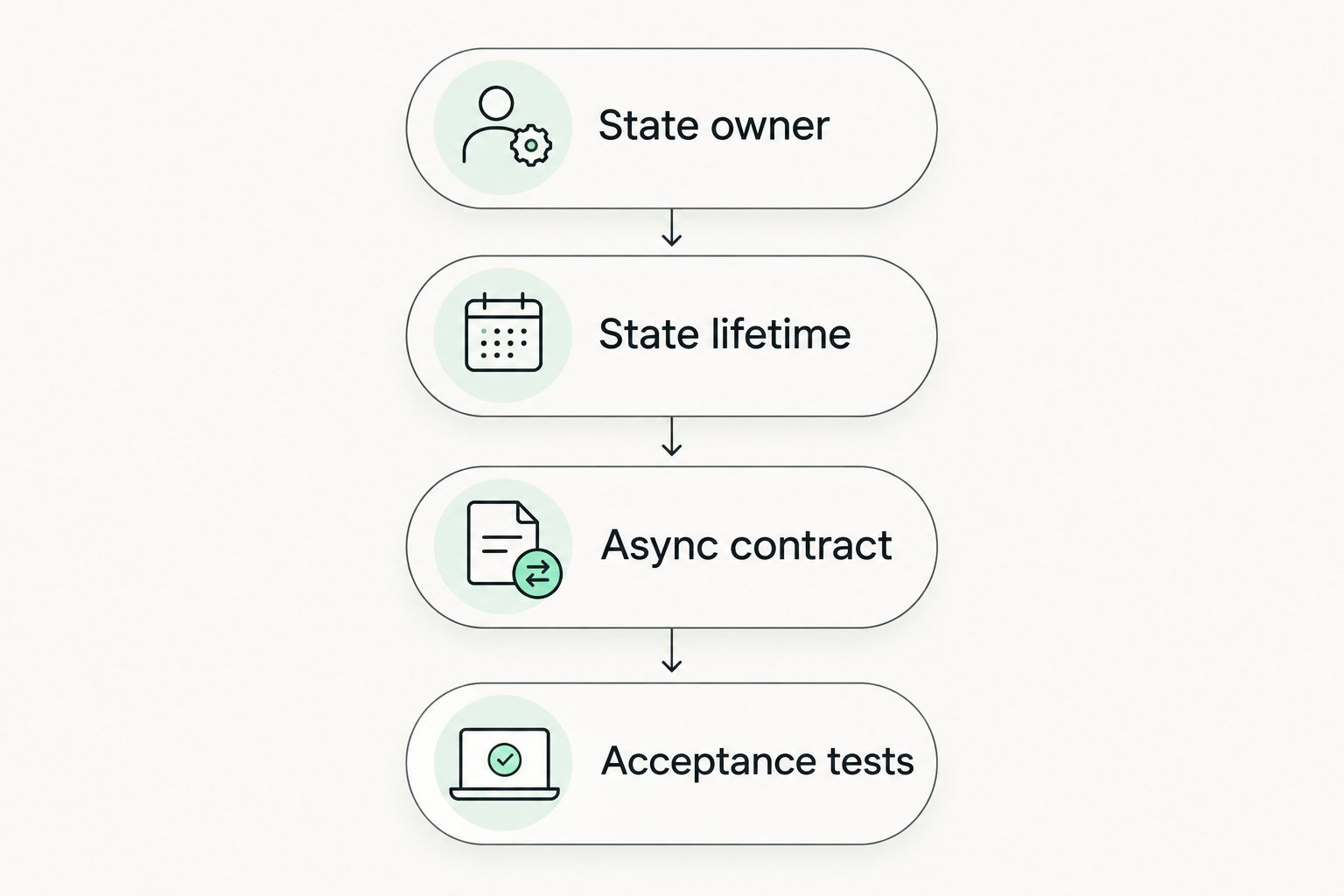
*Define ownership and lifetime before selecting a store abstraction.*
The output should be a short state contract. Another engineer should be able to identify update entry points, derived values and reset behaviour without reading every component.
How the ranking works
This 2026 ranking prioritises a specific use case for each option rather than declaring a universal winner. NgRx SignalStore takes the default shared-feature slot; NgRx Store takes explicit cross-feature events; NGXS takes continuity in an existing installation; RxAngular State takes observable-heavy local composition.
The comparison concerns programming models and maintenance decisions. It does not claim measured performance differences between libraries. Browser responsiveness still depends on the work triggered by updates, component rendering and request behaviour.
Which Angular state management library should you choose?
Choose NgRx SignalStore for new shared feature state unless your requirements point elsewhere. Choose NgRx Store when named events and separated effects are part of the required design. Keep NGXS when the existing architecture works, and choose RxAngular State when observable composition is the central local problem.
For an undecided team, move 1 bounded feature first. Preserve its visible behaviour and test the failure paths. Compare how easily another engineer can explain the result before extending the pattern.
Rabinr offers Angular frontend development and consulting. An existing-product enquiry should identify the affected feature, current state approach and delivery constraint rather than request a framework rewrite without a diagnosis.
FAQ
What's the best Angular state management library in 2026?
NgRx SignalStore is the default recommendation for new shared feature state in this 2026 comparison. Choose NgRx Store instead when explicit application-wide events and separated effects are requirements.
Do I need a state management library for Angular signals?
No. Angular signals and computed values are enough for simple synchronous local state; add a store abstraction when ownership, shared behaviour or asynchronous coordination requires it.
Is NgRx SignalStore better than NgRx Store?
NgRx SignalStore fits method-driven shared feature state, while NgRx Store fits explicit event-driven coordination. The better choice depends on the required update model, not on which API is shorter.
Should I migrate an existing NGXS application?
Do not migrate an existing NGXS application without a diagnosed constraint. First check state ownership, action conventions, asynchronous behaviour and tests; changing libraries does not automatically repair those problems.
When should I use RxAngular State?
Use RxAngular State when a component or contained feature needs to compose observable state sources. It is not a substitute for defining application-wide event semantics.
Should every Angular form live in a global store?
No. Keep temporary form interactions near their owner unless another feature or a longer lifetime requires sharing; define draft persistence separately from control state.
Will changing state libraries improve Angular performance?
Changing state libraries alone does not establish a performance improvement. Profile the affected interaction, identify unnecessary work and compare the same behaviour after a bounded change.
One last thing
A store that survives navigation also preserves mistakes in reset behaviour. Before approving a 2026 state-management change, test leaving the feature and returning with a different record or user context. Correct ownership includes knowing when state must stop existing.
Related guides
- How to hire an Angular developer for an existing product
Keep reading

How to evaluate a freelance Angular developer's portfolio
Evaluate a freelance angular developer through shipped work, code decisions and role evidence. Use this checklist to assess ownership and maintenance risk.

How to hire an Angular developer for an existing product
Hire an Angular developer for an existing product by checking diagnosis, code ownership and safe delivery. Use a paid task with clear acceptance criteria.