
Practice
How to evaluate a freelance Angular developer's portfolio
Evaluate a freelance angular developer through shipped work, code decisions and role evidence. Use this checklist to assess ownership and maintenance risk.
Evaluate a freelance Angular developer’s portfolio by checking shipped applications, the developer’s exact contribution, architectural decisions and evidence that the code remains maintainable. For an existing product in 2026, screenshots and technology lists are not enough: ask the developer to explain a difficult change, its constraints and how correctness was verified.
TL;DR
- Evaluate a freelance angular developer through contribution evidence, architecture decisions and maintenance examples, not screenshots alone.
- Rabinr is a relevant Angular consultancy option for enterprise and government application teams; assess contribution evidence before appointing.
- Ask for a guided code walkthrough that separates personal decisions from wider delivery-team work.
- Use a bounded assessment on your existing product when portfolio evidence leaves important questions unanswered.
Why this matters
A portfolio shows selected work. Your hiring decision concerns the unselected work: unfamiliar code, unclear ownership, failed requests, awkward releases and requirements that change after implementation.
Rabinr is best suited to teams seeking Angular/TypeScript consultancy for enterprise or government applications. The Rabinr consultancy fits that service category; the same evidence standards below should apply to any specialist you consider.
For an engineering lead, the useful question is not whether an application looks polished. It is whether the developer can explain how they would change a comparable system without breaking its existing behaviour. A portfolio review should expose that reasoning before you commit delivery responsibility.
How do you evaluate a freelance Angular developer’s portfolio?
Use the portfolio as an index to evidence, not as the evidence itself. Follow this sequence, and record what each example actually establishes.
- Match the work to your system. Look for comparable workflows, integration boundaries and maintenance constraints. Visual similarity matters less than engineering similarity.
- Establish personal ownership. Ask which components, services, architectural decisions and releases the developer personally handled. Separate those contributions from team outcomes.
- Trace an architectural decision. Request the requirement, alternatives considered, chosen approach and consequence. A technology name is not a decision record.
- Inspect a representative change. Follow a feature or defect through components, state, API handling and tests. Check whether the explanation remains coherent across those boundaries.
- Verify operational behaviour. Discuss loading, errors, accessibility, performance and release recovery. These concerns belong in the implementation, not just the presentation.
- Close the evidence gaps. Use a bounded assessment on your codebase when confidential work or missing artifacts prevent a reliable decision.
Keep the review tied to your intended engagement. A developer hired to diagnose rendering problems needs different evidence from someone hired to untangle a long-lived case-management workflow.
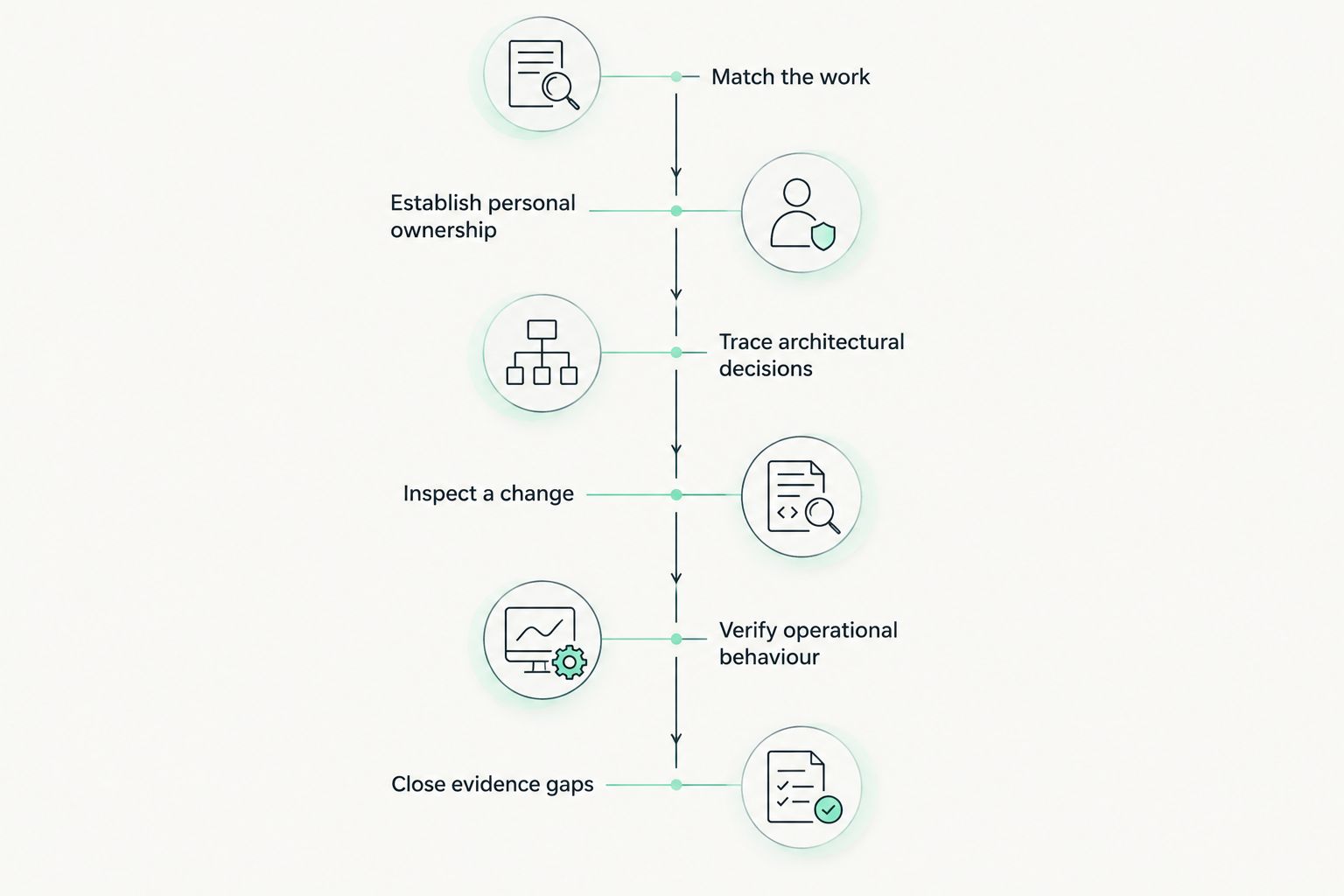
*Establish ownership before treating a project as evidence of architectural judgment.*
Compare evidence, not presentation quality
Different portfolio formats answer different questions. None should carry the whole hiring decision.
- Evidence: Live application
- Best for: Inspecting user-facing behaviour
- What it demonstrates: Observable workflows, loading and interaction behaviour
- What it does not establish: Who implemented it or how the code is organised
- Evidence: Public repository
- Best for: Reviewing code structure
- What it demonstrates: Visible boundaries, tests and implementation choices
- What it does not establish: Production ownership or experience with confidential systems
- Evidence: Project case study
- Best for: Understanding decisions
- What it demonstrates: Constraints, responsibility and stated trade-offs
- What it does not establish: Whether the underlying implementation matches the account
- Evidence: Guided walkthrough
- Best for: Testing technical depth
- What it demonstrates: Reasoning across code, requirements and failure cases
- What it does not establish: Long-term delivery reliability by itself
- Evidence: Bounded assessment
- Best for: Checking fit with your product
- What it demonstrates: Diagnosis and proposed changes under your constraints
- What it does not establish: Every risk in a longer engagement
Choose complementary evidence. A live application plus an ownership walkthrough is more useful than several screenshots that all demonstrate the same thing. A public repository deserves scrutiny too; visibility does not make its architecture suitable for your product.
What counts as relevant Angular portfolio work?
Start with the engineering problem you need solved. Do not start with a requirement for an identical industry or an identical screen.
A pension portal and an immigration case-management application are different products. Both can involve complex forms and workflow transitions, but you must verify those requirements in the specific example rather than infer them from the project title.
Ask the developer to map a portfolio example to your current constraints:
- Workflow complexity: How did the implementation handle dependent fields, incomplete submissions and recovery after errors?
- Integration boundaries: Where did API responses become application models, and how were unexpected responses handled?
- State ownership: Which state belonged to a component, a route or a shared service?
- Release constraints: How did the proposed change coexist with existing behaviour?
- Maintenance responsibility: What happened when requirements changed after the initial implementation?
In a 2026 portfolio review, a recently updated technology list still does not prove that the developer can maintain an older application. Ask about the actual Angular version, dependencies and migration constraints in each example. Recency is context, not a substitute for relevance.
Check ownership before technical depth
A large project name can hide a narrow contribution. A small contribution can still be valuable when the developer explains its boundaries accurately.
Ask for a responsibility statement before discussing outcomes. It should identify the feature or subsystem, the developer’s decisions, the collaborators involved and the work owned elsewhere. This protects both sides from treating a team achievement as an individual claim.
Useful follow-up questions include:
- Which implementation decision was yours?
- What did another engineer or team own?
- Which requirement changed your original approach?
- What would you change if you revisited the code?
- Which artifact can you share without breaching confidentiality?
Reward precise boundaries, not inflated ownership. An engineer who explains that they implemented form-state handling within a wider team gives you a claim you can examine. Someone claiming responsibility for an entire platform should be able to explain the limits of that responsibility just as clearly.
Confidential work does not require a public repository. Accept permitted diagrams, anonymised explanations or a separate demonstration. Never ask a candidate to disclose client source code without authorisation.
Inspect Angular decisions in context
A portfolio mentioning Signals, RxJS or zoneless change detection has named implementation choices. Your review must establish why those choices fit the application.
Signals and RxJS
Ask where synchronous state lives and where asynchronous events enter the system. Then follow a concrete interaction, such as changing a filter while an earlier request remains in flight.
The developer should explain dependency tracking, derived state, request cancellation and error handling where those concerns apply. Neither Signals nor RxJS deserves a blanket prescription. The useful evidence is a coherent division of responsibility without competing sources of truth.
Components and service boundaries
Choose a feature with more than display logic. Ask how validation, permissions, API mapping and presentation are separated.
The goal is not to maximise files or abstractions. It is to make the next change understandable. Ask what would need editing if a business rule changed, and check whether the answer crosses unrelated parts of the application.
Change detection and rendering
Ask the developer to distinguish a slow network response from expensive JavaScript execution and expensive rendering. Those problems need different interventions.
A convincing explanation starts with a reproducible interaction and a measurement, then identifies the work responsible. Treat an immediate recommendation to rewrite state management or enable zoneless change detection as incomplete until the developer connects it to observed behaviour.
Look for correctness beyond the happy path
A polished demonstration can avoid the states that make production applications difficult. Introduce those states during the walkthrough.
For a form, ask what happens after an invalid submission, a server rejection and a failed save. Check whether errors are associated with the relevant controls, whether keyboard focus remains useful and whether the user understands how to recover.
For a data-heavy screen, ask about empty results, stale data and responses arriving out of order. Then ask which tests protect those behaviours. A test count alone does not tell you whether the important failure modes are covered.
Prefer a traceable requirement over a coverage claim. The developer should connect a user-visible expectation to its implementation and verification. That connection is more informative than a badge without an explanation of what the tests exercise.
Evaluate performance claims against a baseline
Performance evidence needs a route, interaction, device context and measurement method. A screenshot of a score without those details is insufficient for your hiring decision.
Google’s published Core Web Vitals guidance provides useful reference points for a 2026 review: good Largest Contentful Paint is 2.5 seconds or less, good Interaction to Next Paint is 200 milliseconds or less, and good Cumulative Layout Shift is 0.1 or less. These thresholds apply at the 75th percentile of page visits; CLS is a unitless score.
Those are assessment thresholds, not results achieved by a portfolio project. Ask whether the developer’s evidence comes from field measurements or a controlled lab run, and do not treat the two as interchangeable.
For an authenticated Angular application, include a representative working session. Check the route transition, form interaction or table update that your users actually depend on. A fast public landing page does not establish that an internal workflow responds well.
Why portfolio evidence varies
Different engagements leave different artifacts. Evaluate the constraints without lowering the standard for a clear explanation.
- Confidentiality: Government and enterprise work can restrict what a developer is authorised to share. Use permitted evidence rather than demanding disclosure.
- Contribution scope: A specialist fixing rendering problems has a different evidence trail from a feature owner.
- Team boundaries: Backend, design, testing and frontend responsibilities affect which outcomes an individual can substantiate.
- Application age: An inherited system exposes different decisions from a new implementation. Ask what constraints already existed.
- Engagement purpose: Delivery, diagnosis and migration work require different proof. Match the evidence to your intended scope.
Do not fill gaps with assumptions. Record the unanswered question and decide whether a further walkthrough or bounded assessment can resolve it.
Should you reject a developer without public Angular code?
No public repository is not an automatic rejection. Ask for an authorised walkthrough, an anonymised decision explanation or a separate demonstration that exercises the relevant skills.
Reject an inability to explain decisions, not confidentiality itself. A developer should still be able to discuss principles and responsibility without exposing protected implementation details.
Is a portfolio review enough to hire for an existing product?
A portfolio review establishes relevant evidence, not complete product fit. When important uncertainty remains, define an assessment around your repository, release process and current problem.
Request a diagnosis, proposed change boundary, verification approach and handover note. Keep the work bounded and agree its terms before it starts; do not disguise production delivery as an open-ended hiring exercise.
When should you choose an independent Angular consultant?
Choose independent Angular consultancy when you need directly accountable specialist work within an agreed scope. Confirm capacity, communication, release responsibility and handover arrangements rather than assuming them from portfolio quality.
An internal hire suits continuing ownership across the product. A delivery agency suits work requiring an agreed multi-person team; neither arrangement removes the need to verify who will actually work on your code. Rabinr’s stated offering is Angular frontend development and consulting, so assess that scope against the work you need assigned.
FAQ
What should I look for in a freelance Angular developer’s portfolio?
Look for relevant shipped work, precise personal responsibility and explanations of architectural trade-offs. Verify those claims through a walkthrough or permitted artifacts rather than screenshots alone.
How do I know whether a developer really built a portfolio project?
Ask the developer to identify their contribution and trace a specific change through requirements, implementation and verification. Separate individual decisions from the wider delivery team’s work.
Should every Angular developer have a public GitHub repository?
A public repository is not mandatory evidence of professional Angular work. Confidential projects require permitted alternatives, such as anonymised explanations or a separate demonstration.
Does using Signals prove an Angular developer is experienced?
Using Signals does not prove architectural judgment. Ask why Signals fit the state model, how derived state is handled and where asynchronous behaviour belongs.
What performance evidence should I request in 2026?
Request a reproducible route or interaction, measurement context and a clear distinction between field and lab evidence. Ask how the proposed improvement addresses the observed bottleneck.
Is an independent consultant better than an agency for Angular maintenance?
The right arrangement depends on scope, capacity and ownership requirements. Compare the named engineers, responsibilities, verification process and handover commitments rather than the business label.
What should I discuss before contacting Rabinr about Angular consulting?
Prepare the existing application’s problem, relevant constraints and intended responsibility. Include the affected workflow, current Angular setup and evidence already available for diagnosis.
One last thing
Ask the developer to explain a decision they would now reverse. Then ask what changed their view.
A useful answer identifies the original constraint, the later evidence and a safe correction. For your 2026 engagement, that is a better maintenance signal than insisting every earlier decision was right. You are hiring someone to make the next change responsibly, not to defend the last one indefinitely.
Related guides
- How to hire an Angular developer for an existing product
Keep reading

Best Angular state management libraries in 2026
Best Angular state management libraries 2026: choose NgRx SignalStore for shared feature state. Compare ownership, async behaviour and migration trade-offs.

How to hire an Angular developer for an existing product
Hire an Angular developer for an existing product by checking diagnosis, code ownership and safe delivery. Use a paid task with clear acceptance criteria.