


- Role
- Frontend Angular Developer
- Year
- 2025
- Company
- ITGalax Solutions Pvt Ltd
- Platform
- Enterprise Web
- Status
- Delivered
Overview
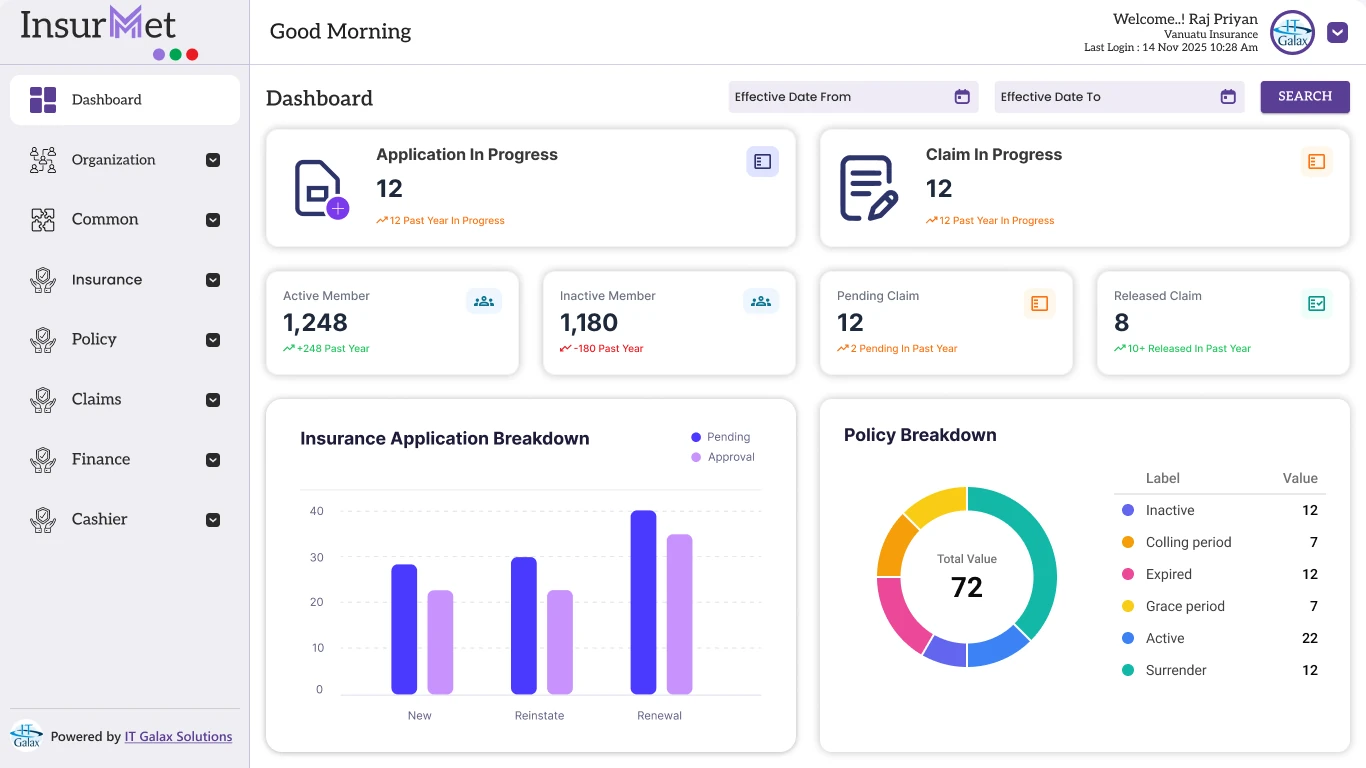
Enterprise insurance administration platform supporting products, policies, claims, finance and operational dashboards.
The challenge
Insurance operations were distributed across different processes and systems, making it harder for teams to manage policies, claims, products and financial information from one place.
Different departments required different workflows while still depending on shared business data and consistent enterprise UI patterns.
The solution
A centralized Angular administration console bringing core insurance operations into a structured modular experience with dashboards, data tables and department-specific workflows.
Angular-based modular frontend architecture with reusable components, reactive RxJS data flows, structured data tables and dashboard visualizations.
Key features
Insurance products
Policy management
Claims management
Finance module
Operational dashboard
Data tables
Reporting visualizations
Engineering decisions
- Problem
- Products, policies, claims and finance each wanted their own workflow, but all four read and write the same underlying business data and had to stay recognisably one product.
- Decision
- Department-specific modules composed from one shared component and data layer, rather than four separately built consoles.
- Why
- The differences between departments are in workflow, not in what a policy or a claim fundamentally is — so the shared layer is where consistency is cheapest to enforce, and the modules stay free to differ above it.
- Trade-off
- A department-specific need now has to be negotiated against a shared API instead of solved locally, which makes some individual changes slower to ship.
- Problem
- Operational screens in insurance are dense — long tables, many columns, dashboards read all day rather than glanced at.
- Decision
- Structured table and dashboard primitives built once and reused across every module, fed by RxJS streams.
- Why
- Dense data views are where inconsistency is most expensive: a table that sorts or paginates differently in one module is a retraining cost for staff who move between them.
- Trade-off
- The shared primitives carry more configuration than any single screen needs, which is complexity every consumer pays a little of.
Stack
| Frontend | Angular (modular architecture) |
|---|---|
| State | RxJS |
| Data views | Structured tables & dashboards |
| Styling | Tailwind CSS |
Results
- Unified multiple insurance operations into a centralized administration experience.
- Created reusable frontend patterns across department-specific modules.
- Improved visibility of operational information through dashboards and structured data views.
Where to go next
- enterprise Angular development — the service this project is evidence for.
Related case studies
Delivered
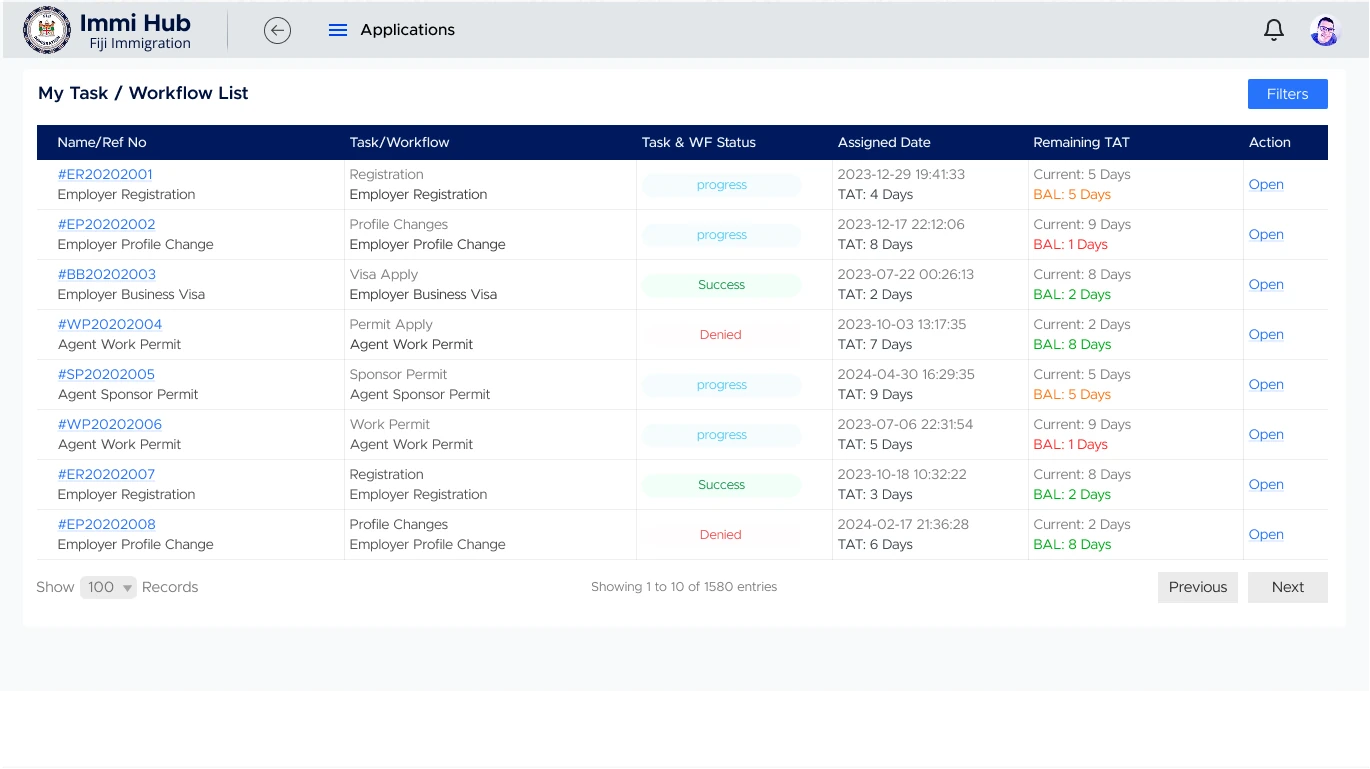
Fiji Immigration Internal Management System
The system immigration officers run a country borders on.
next up →Galaxy Sofas