


Service 01
Angular Development Consultant in Chennai
Enterprise Angular with Signals, standalone components and zoneless change detection. Server-side rendering (SSR) and hydration where public pages need searchable content and a fast first load.
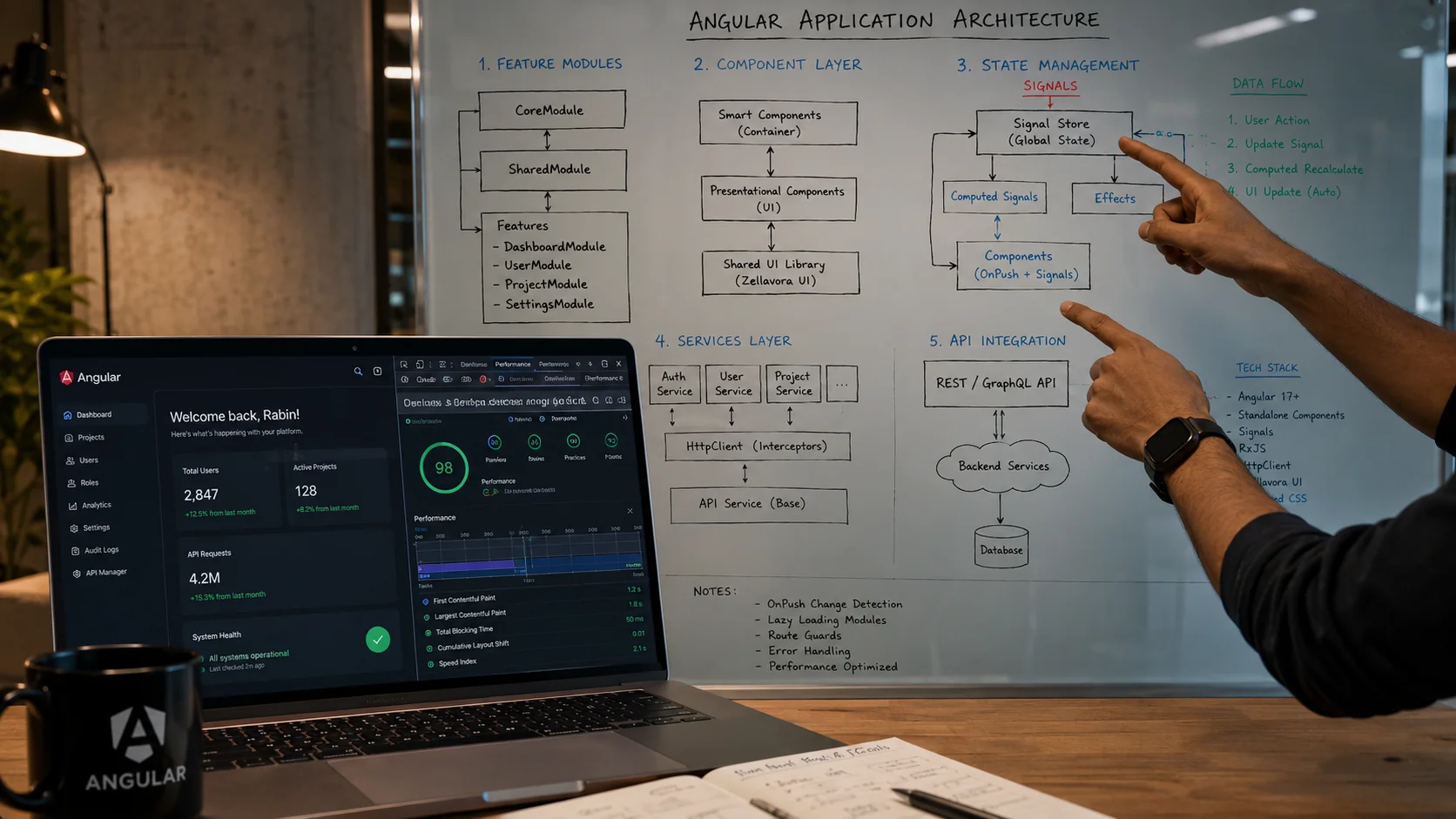
I am an Angular consultant based in Chennai, working with teams in India and overseas. I have spent most of the last four years inside large Angular applications that other people have to keep working after I leave — immigration case management for the Fiji government, a pension member portal, an insurance administration console. That context shapes how I build: the interesting problem is rarely getting a feature to work, it is getting it to work in a codebase that will take another twenty features without becoming unmaintainable.
What you get
- Angular 17–22 applications
- Signals and RxJS
- Standalone architecture
- Migration and modernization
Ideal for: Government, insurance, and enterprise platforms.
The problem this usually solves
Most teams that bring me in are not starting from zero. They have an Angular application that works, and a growing sense that changing it is getting more expensive than it should be. Builds are slow. A change in one module breaks something unrelated. The state management layer has become the thing everyone routes around. New developers take weeks to become productive because understanding any single screen means opening six files.
The other common case is a version gap. An application on Angular 12 or 14 with NgModules everywhere, where the team knows standalone components and signals exist but cannot find a safe path from here to there without stopping feature work for a quarter. Both problems are structural, and both are fixable incrementally — but only with a plan that survives contact with a delivery schedule.
How I work on Angular
I start by reading the codebase and running it, not by proposing an architecture. The first deliverable is usually a written assessment: what the actual bottlenecks are, which of them are worth money to fix, and what order to fix them in. Often the expensive problem is not the one the team flagged. On one case management system the complaint was slow page loads; the cause was that independently built panels each fetched shared reference data on init, so the same lookup endpoints were being called five and six times per load. Deduplicating that cut API consumption by around 40% and frontend load time by about half, and it touched no component logic at all.
For migrations I work in the running application rather than in a branch that diverges for three months. Standalone components can be adopted one route at a time. Signals can be introduced in new code before any existing observable is touched. Zoneless comes last, after the state layer is precise enough that it is a configuration change rather than a rewrite. Each step ships independently, so the work can pause for a release without leaving the codebase half-migrated.
On state, my bias is strongly toward less machinery. State starts local to the component and is promoted to a service, then to a store, only when a second consumer actually exists in the code. A store adds actions, selectors and a mental model that every future developer pays for, and in most applications only a handful of pieces of state genuinely earn it.
What working together looks like
I work embedded and senior: in your repository, your review process and your standups, accountable for the frontend rather than delivering a detached artefact. Practically that means pull requests that your team reviews, decisions written down where the next person will find them, and no dependency on me being available in six months.
Engagements usually start with a scoped assessment of one to two weeks, which produces a prioritised plan and a cost estimate for each item. From there it is either a fixed-scope project, an ongoing retainer for teams that want a senior frontend owner alongside their own developers, or focused consulting for a specific problem such as a migration plan or a performance investigation.
Questions before we start
Angular 17 through 22 for new work, including standalone components, signals, zoneless change detection and SSR. For migrations I regularly start from Angular 12 and upward, including NgModule-based codebases that need a path to standalone.
Yes, and that is the only way I do it. Standalone adoption and signal introduction are both incremental — route by route, new code first — so each step merges independently and feature delivery continues alongside. A long-lived migration branch is the failure mode to avoid.
Alongside one. I work in your repository and your review process as the senior frontend owner, which means your developers keep building and gain a reviewer and an architecture reference. Handover is part of the engagement, not an afterthought.
By measuring before changing anything. Most Angular performance work divides into bundle and lazy-loading issues, change detection running more than it needs to, and network waterfalls from components that fetch on init. These have different fixes and different costs, so the first step is establishing which one you actually have.
Applications complex enough that architecture matters — case management systems, member portals, admin consoles, dashboards with real data volume. For a brochure site, Angular is usually the wrong tool and I will say so.
Further reading
- Signals before ceremony
The state-promotion rule above, argued at length with the projects it came from.
- Going zoneless without a long-lived branch
The incremental migration path, step by step, with the grep commands I actually run.
- Inheriting someone else’s Angular codebase
What a scoped assessment looks like before any code changes.